
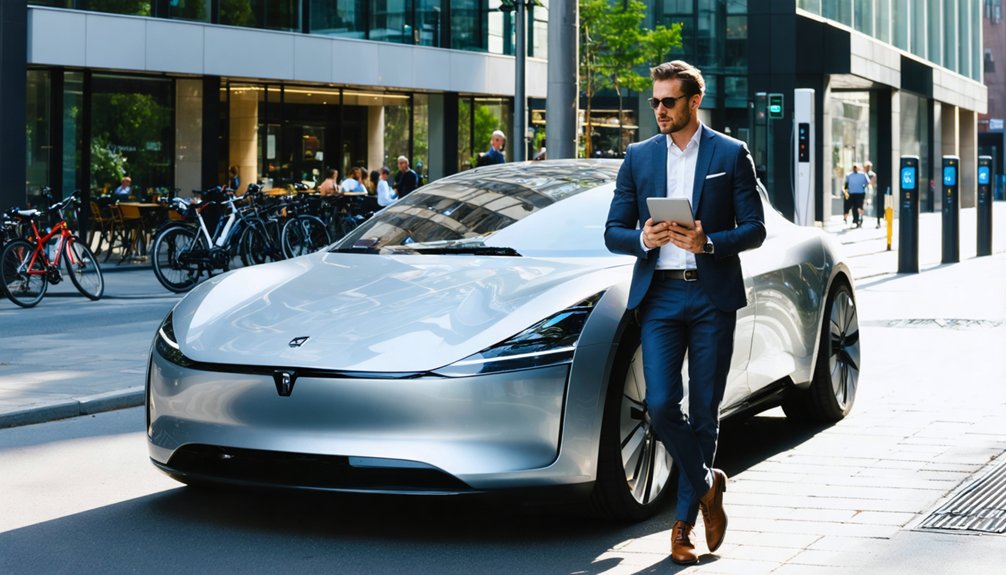
Zero‑percent APR eliminates interest, but borrowers must assess loan length, eligibility, and hidden fees. Compare lease versus purchase cash‑flow, noting due‑at‑signing costs and total cost over the vehicle’s life. Factor bonus cash, federal tax credits, and trim caps, ensuring incentives stack without violating caps. Evaluate APR discounts from green‑programs, automatic‑payment incentives, and credit‑union offers, while checking documentation and origination charges. Timing the deal—end‑of‑month or model‑year—can reveal additional savings, and used‑EV financing requires battery health verification and total‑cost‑of‑ownership analysis, which the following sections explore.
Key Takeaways
- Compare 0% APR promotional loans versus standard APR loans to gauge interest savings and monthly payment differences.
- Evaluate total‑cost impact of incentives, including federal tax credits, utility cash bonuses, and APR discounts, while noting eligibility caps and stacking rules.
- Assess lease versus purchase cash‑flow trade‑offs, considering lease residual risk and equity buildup over the vehicle’s ownership period.
- Verify lender requirements such as credit score, down‑payment size, and battery health verification, which affect APR and loan‑to‑value ratios.
- Time negotiations for end‑of‑month or model‑year clearance periods to maximize dealer incentives and price reductions.
2’s APR Financing Basics: What 0% APR Really Means for Your Wallet
How does a 0 % APR loan actually affect a buyer’s wallet? A 0 % APR vehicle loan requires principal‑only payments, meaning every monthly amortization reduces the borrowed amount without interest accrual.
For a $25,000 loan over 36 months, the buyer pays $694 each month, totaling exactly $25,000, whereas a 5 % APR loan of the same principal over 60 months would total $28,320. The interest saved—$3,320—appears as direct cash flow benefit, but the shorter term forces higher monthly outlays.
Qualification demands excellent credit, often limited to specific models, trims, and regions, with occasional down‑payment requirements. Manufacturer bonuses, such as $5,000 cash rebates, may accompany the 0 % offer, further enhancing net savings while preserving the principal‑only payment structure. Some dealers offer 0% financing up to 72 months on select EVs like the 2025 Acura ZDX. The 2026 Hyundai IONIQ 5 also provides a regional bonus of $5,000 with manufacturer financing, illustrating how additional cash incentives can amplify the benefit of a 0 % APR loan. Limited promotional length is typical, often 36‑48 months, to minimize lender exposure.
How to Compare Lease vs. Purchase: Monthly Payments, Due‑at‑Signing, and Total Cost
Zero‑percent APR loans illustrate the cash‑flow advantage of interest‑free financing, but many buyers still weigh whether a lease or outright purchase better aligns with their financial goals.
Lease monthly payments, typically £200–£800, reflect only depreciation plus finance charges and are on average $175 lower than auto‑loan payments. Due‑at‑signing costs are modest, often a deposit and first month, allowing lower upfront incentives and preserving cash. Total lease cost over two three‑year terms reaches about £19,800, with no equity and a residual risk that the vehicle must be returned. Low‑mileage drivers may find leasing especially attractive due to mileage limits. Tax‑efficient salary‑sacrifice leasing often provides the greatest cost savings for employees. Federal tax credit removal has reduced direct buyer savings, making the cash‑flow advantage of leases more compelling. Purchase payments are higher because they cover the full vehicle value and interest, but a larger down payment reduces monthly outlay and builds equity. Over six years, ownership costs less, depreciation stabilizes, and the residual value becomes an asset, though the buyer bears full depreciation risk.
Decoding Bonus Cash and Purchase Credits: Stacking, Trim Restrictions, and Real Savings
Why does the interplay of bonus cash, federal tax credits, and trim‑level restrictions matter to EV buyers?
Bonus cash from utilities such as Duquesne Light ($50) and PECO ($50) can be claimed without a purchase condition, but each vehicle receives only one utility payment.
Federal credits—up to $7,500 for new models and $4,000 for used—are non‑stackable with other federal programs yet may be combined with utility cash under the stacking rules.
Trim implications are critical: MSRP caps ($55,000 for sedans, $80,000 for SUVs/trucks) and battery‑size thresholds exclude higher‑trim versions, effectively disqualifying luxury trims despite North‑American assembly.
When a qualifying trim meets all criteria, the buyer can realize a net reduction of roughly $7,550, comprising the tax credit plus any applicable utility bonus cash.
Income caps also limit eligibility, ensuring that only taxpayers with adjusted gross incomes below the specified thresholds can claim the credit. North‑American assembly is required for new‑vehicle eligibility. Vehicle must be used primarily in the U.S. is another essential condition for qualifying for the credit.
Evaluating APR Discounts: Green‑Program Rates, Automatic‑Payment Incentives, and Credit‑Union Offers
When evaluating APR discounts for electric‑vehicle financing, buyers should first compare green‑program rates, automatic‑payment incentives, and credit‑union offers to determine the net reduction in borrowing cost.
Green‑program discounts typically shave 0.25‑0.50 % off the APR, and when stacked with green rebates and other promotions can yield $2,000+ in interest savings over a five‑year term.
Automatic‑payment incentives add another 0.25‑1.0 % reduction, especially when bundled with insurance or direct‑deposit benefits, demonstrating lender flexibility.
Credit unions often provide mid‑5 % to mid‑7 % APRs, with member‑exclusive rates such as 4.073 % for new EVs, and may include cash‑out incentives for home chargers.
Longer loan terms increase total interest, so even a modest APR reduction can significantly lower overall cost.
Timing Your Deal: Why End‑of‑Month and Model‑Year End Dates Can Save You Money
Amid the final days of a month, dealers scramble to meet sales quotas, creating a window where negotiation power shifts decisively toward the buyer. Dealer psychology drives aggressive pricing as monthly targets loom, and promotion timing aligns with cash‑incentive deadlines.
End‑of‑month offers such as $10,000 Kia EV9 bonuses and 0% APR on the 2025 Ford Mustang Mach‑E illustrate how volume pressure translates into tangible savings. Model‑year end clearance further amplifies discounts: 2025 Hyundai IONIQ 6 leases drop to $267/month, while the 2026 Honda Prologue $15,000 discount expires 03/31.
Expiring HMF APR deals and regional lease specials reinforce the urgency, making the last days of March a prime period for EV financing optimization.
Hidden Fees and Warranty Bundles: What to Look for in Captive Finance Packages
Dealers often leverage end‑of‑month urgency to push captive finance packages that appear attractive on the surface but conceal a range of fees and mandatory warranty bundles.
Captive lenders embed documentation fees of $500‑$1,000, origination charges of 2‑5 % of the loan, and pre‑payment penalties that erode early‑payoff savings. Bundled warranties extend battery coverage to 8‑10 years but exclude brake, suspension, and high‑voltage repairs after eight years, while prepaid maintenance and roadside assistance increase monthly outlay. Some offers tie charging infrastructure subsidies to the warranty, inflating the perceived value.
Hidden state fees—up to $400 in Texas and $230 annually in Georgia—are omitted from APR calculations, undermining resale protection by raising total cost of ownership.
Leveraging Used EV Financing: Green Promos, Battery Health Checks, and Total‑Cost‑of‑Ownership Calculations
In recent years, green financing options have reshaped the used‑EV market, offering mid‑5 % to mid‑7 % APRs through credit unions, sub‑national rates from community banks, and occasional zero‑percent promos from automakers such as Toyota’s 2026 bZ and Tesla’s Model 3.
Lenders prioritize battery health checks, using Recharged Score Reports to confirm battery longevity and set higher loan‑to‑value ratios.
Certified pre‑owned EVs with verified battery condition qualify for 0.99 % APR and 0 % promotional rates, while community banks shave rates below national averages.
Borrowers must run total‑cost‑of‑ownership calculations, balancing longer 60‑84‑month terms against accrued interest, electricity savings, and higher insurance premiums.
Accurate resale forecasting, based on battery health and market supply, guides ideal financing structures and mitigates residual risk.
Building Your Decision Framework: Prioritizing APR, Term Length, Incentives, and Cash‑Flow Needs
Balancing APR, loan term, incentives, and cash‑flow requirements forms the core of an EV financing decision framework.
Borrowers should first conduct priority mapping, ranking lower APR against longer terms, incentive capture, and monthly cash‑flow tolerance.
Scenario modeling quantifies how a 6.07% versus 10.26% rate, a 68‑month versus 74‑month term, and a $7,500 federal credit alter total cost and payment size.
Higher credit scores reduce APR, while larger down payments shrink loan balance and interest exposure.
Incentives that integrate rebates or charger installation can shift effective APR.
Cash‑flow analysis must compare loan versus lease payment gaps, typically $175 per month, to make sure sustainable budgeting.
This structured approach yields an optimal, data‑driven financing choice.
References
- https://www.carsdirect.com/deals-articles/best-ev-financing-deals
- https://evdances.com/blogs/blog/best-ev-lease-deals-and-financing-offers-in-february-2026
- https://electrek.co/2026/01/23/all-the-evs-you-can-buy-with-0-financing-in-january-2026/
- https://recharged.com/articles/best-used-ev-loan-rates
- https://www.carfax.com/deals/electric-car-lease-deals
- https://www.youtube.com/watch?v=LwRMUX6VeSE
- https://www.kbb.com/car-advice/lease-buy-electric-car/
- https://electrek.co/2025/06/23/all-the-evs-you-can-buy-with-0-interest-financing-in-june-2025/
- https://www.carsdirect.com/deals-articles/best-zero-percent-financing-deals
- https://www.kbb.com/car-advice/zero-apr-guide/

